Unit IV — Leadership & Motivation / Chapter 25
Leadership Foundations
M-IGO-B · 2026 Teaching Edition
Learning outcomes
- Explain leadership foundations and distinguish the chapter's central concepts.
- Use initiating structure, consideration, situational leadership to frame a workplace diagnosis.
- Interpret the reported indicators while distinguishing observation, inference and missing evidence.
- Compare the case alternatives and justify a decision using theory, trade-offs and an evaluation plan.
Understanding the concept
Leadership can be examined through qualities of the leader, patterns of behaviour and the demands of the situation. These approaches answer different questions. A technically capable manager may still need to learn how to coordinate people whose experience, expectations and work conditions differ.
Leadership effectiveness depends on the fit between a leader's behaviour and the demands of the situation, not on a fixed set of traits alone. Ohio State studies split leader behaviour into initiating structure (task focus) and consideration (people focus), while Fiedler's contingency model and Hersey-Blanchard's situational model argue that the right mix shifts with follower readiness and task structure. A technically brilliant individual contributor promoted into a leadership role must consciously relearn which behaviours to emphasise.
Trait approaches draw attention to leader characteristics without providing a universal recipe. Behavioural approaches distinguish task structuring from consideration for people: clarifying duties and listening to concerns need not be opposites. Contingency approaches ask whether leadership fits the task, relationships and authority conditions. Situational ideas emphasize the support and direction that particular work demands. These are interpretive frameworks, not fixed identities assigned to a leader by a photograph, a poster or a brief story.
- 1Concept: explain the mechanism
- 2Construct: define what matters
- 3Evidence: examine the signals
- 4Decision: weigh and justify
- 5Review: learn from consequences
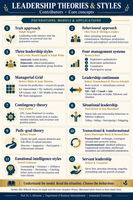

Core components and theoretical lenses
Use the following distinctions to unpack the chapter's central idea. Each identifies a different aspect of the problem; their relationships matter as much as the labels themselves.
- 01
Trait approach: drive, self-confidence, integrity, cognitive ability
- 02
Initiating structure: defining roles, schedules, and task expectations
- 03
Consideration: trust, respect, and concern for subordinate welfare
- 04
Situational/contingency fit: matching style to follower maturity and task structure
- 05
Leader-member exchange quality within diverse, unequal-tenure teams
Conceptual constructs
A construct names an idea used to interpret behaviour. It is not directly interchangeable with a survey score or a single incident. In this chapter, the constructs below organize the diagnosis; examine how they could explain the observations before deciding what to change.
- initiating structure
- consideration
- situational leadership
- leader-member exchange
- follower readiness
Observable and measurable indicators
Indicators connect an abstract explanation to something that can be observed. Check the operational definition, reporting period and comparison group. A survey average can conceal differences between teams, and an administrative record can reflect willingness to report as well as underlying behaviour.
- Team goal clarity, measured via a quarterly role-clarity survey score
- Grievance and conflict-referral frequency to HR per quarter
- Supervisor-rated versus peer-rated leadership style gap in 360 feedback
- Shift-level productivity variance across leader-led teams
- Voluntary attrition among first-line operators within 12 months of a new leader's appointment
Storytelling / hypothetical teaching case
A workplace decision
Ashish Bhosale, a senior process engineer at Bharat Auto Components in Pune, was promoted to shift manager after eight years on the shop floor, now supervising 42 machine operators, fitters, and quality inspectors across three age and skill bands. Within two months, operators complained he issued detailed technical instructions but rarely acknowledged personal problems like transport issues or family emergencies, while two senior fitters felt micromanaged despite 15 years of experience. Shift output dropped 6 percent even though Ashish worked 11-hour days trying to fix machine-level issues himself. HR flagged rising absenteeism (up from 3 percent to 7 percent) and one resignation citing "no one listens to us." The plant head must decide how to coach Ashish before the next appraisal cycle.
The organization, characters and reported figures are supplied teaching material, not a verified corporate case report.
Reading the case evidence
Separate what the case reports from what you infer. A figure can establish the scale of a problem without establishing its cause. Note what information is absent and how that gap affects your confidence in a recommendation.
| Signal | Reported teaching-case evidence |
|---|---|
| Shift output change | -6% over two months |
| Absenteeism | 3% to 7% |
| 360-degree consideration score | 2.1/5 from peers vs 4.0/5 self-rated |
| Operator tenure spread | 1 to 18 years |
| Grievance filings this quarter | 5, up from 1 |
Decision alternatives and trade-offs
Alternatives represent different priorities and assumptions. The advantages and limitations below are the existing module's analytical prompts. Compare them against the same evidence rather than choosing first and finding a theory afterward.
ASend Ashish for a structured leadership coaching program
Enrol him in a 6-week behavioural coaching program emphasising consideration behaviours and delegation, paired with a mentor manager.
Potential advantages
- Builds durable behavioural change
- Signals organizational investment in him
Limitations and risks
- Slow to show results
- Coaching quality is uneven if vendor is weak
BPair Ashish with an experienced assistant supervisor
Assign a people-oriented assistant shift lead to handle consideration-heavy tasks like grievance handling and informal check-ins.
Potential advantages
- Immediate relief for team morale
- Low cost, uses existing staff
Limitations and risks
- Ashish may not develop the skill himself
- Creates ambiguity about who is really in charge
CDifferentiate leadership style by follower readiness
Coach Ashish to use directive style with newer operators and delegating/participative style with the experienced fitters, per situational leadership.
Potential advantages
- Matches Hersey-Blanchard logic to real team composition
- Improves both output and senior-operator autonomy
Limitations and risks
- Requires Ashish to accurately diagnose readiness levels
- Needs ongoing HR support to reinforce
DRevert Ashish to a senior technical specialist role
Move him back to an individual-contributor technical lead position and promote someone else to shift manager.
Potential advantages
- Removes a mismatched leader quickly
- Retains his technical value to the plant
Limitations and risks
- Costly and demoralising after investing in the promotion
- Does not build the plant's leadership pipeline
Evidence-based discussion
In the promoted-manager case, identify which problems require technical direction and which require relationship-building or employee participation. Read the visual posters alongside the conceptual account rather than treating illustrated corporate figures as validated classifications. Compare alternatives by their fit with workforce needs and operational constraints. A credible leadership plan includes how the manager will gather feedback and adjust, not just the name of a preferred style.
Theory-linked interpretation from the module
A strong answer should draw on the Ohio State two-dimension model to diagnose Ashish's imbalance (high structure, low consideration) and on situational leadership theory to argue that a single fixed style cannot serve both novice and veteran operators. Contingency theory (Fiedler) would frame whether the situation itself, not just the leader, needs adjusting, for example by improving leader-member relations or task structure. Candidates should weigh speed of relief against durability of the behavioural change.
Your managerial judgement
Which intervention should the plant head choose to fix Ashish's leadership gap, and how would you justify it using trait, behavioural, and contingency perspectives?
Write a recommendation that identifies a preferred alternative, uses the reported evidence, acknowledges uncertainty and specifies a review point. Another choice can be defensible when its assumptions and trade-offs are made explicit.
Possible consequences
The module offers the following projections for discussion. They depend on implementation and context; they are not guaranteed effects or verified forecasts.
- Short term: faster resolution of operator grievances if an assistant or coach absorbs consideration duties
- Short term: risk of confused authority lines if responsibilities are split without clarity
- Long term: Ashish's leadership capability either matures into a plant asset or the plant loses a good engineer
- Long term: attrition trend either reverses, protecting institutional knowledge, or worsens, raising hiring costs
- Long term: precedent set for how the plant coaches future technical-to-managerial promotions
Reflection questions
- Was Ashish set up to fail by being promoted without leadership preparation?
- How should organizations balance technical expertise against people-leadership readiness in promotion decisions?
- Can consideration behaviours be coached, or are they closer to stable traits?
- What follower-side responsibilities exist in helping a new leader succeed?
Practice: Know → Analyse → Decide
These are the original module questions. Reading or printing this textbook does not change quiz scores, completion or certificate eligibility.
Know Question 25.1
In the Ohio State studies, 'consideration' primarily refers to:
- Defining tasks and schedules precisely
- Trust, respect, and concern for subordinates' welfare
- A leader's cognitive ability and drive
- Matching leadership style to task structure
Answer and explanation
B. Consideration captures relationship-oriented behaviours like trust and concern for followers, distinct from task-oriented initiating structure.
Analyse Question 25.2
Ashish's 360 data shows high self-rated consideration (4.0/5) but low peer-rated consideration (2.1/5). This gap most likely indicates:
- Peers are rating dishonestly out of resentment
- A perception gap where Ashish believes he shows concern but it is not experienced that way by the team
- The survey instrument is invalid
- Ashish actually excels at initiating structure and consideration equally
Answer and explanation
B. Self-other rating gaps commonly reveal a blind spot: intended behaviours are not landing as perceived support, a key coaching target.
Decide Question 25.3
Given the mixed-tenure team and time pressure before the next appraisal, which option best balances speed and durability?
- Option D: revert Ashish to a technical role immediately
- Option C: coach Ashish to differentiate style by follower readiness, using situational leadership
- Option A alone, with no other changes
- Do nothing and wait for the next appraisal cycle
Answer and explanation
B. Differentiating style by readiness directly addresses the diagnosed problem (uniform directive style across a mixed team) while keeping Ashish in role and building capability.
Continue with interactive learning
Interactive module: https://migob.lovable.app/learn/25 · Decision Lab: https://migob.lovable.app/decision-lab