Unit IV — Leadership & Motivation
26. Contemporary Leadership
Leadership in Action — optional visual reference
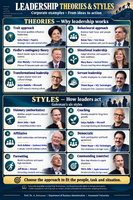
Application: Corporate Leadership Examples
Corporate examples are teaching illustrations for applying leadership ideas; they are not fixed personality labels or formal assessments.
Readable text: applying leadership in corporate settings
Corporate examples are teaching illustrations for applying leadership ideas; they are not fixed personality labels or formal assessments.
Neha Krishnan leads a 300-person operations division at Suvidha Logistics, a mid-size logistics firm digitizing its warehouse and dispatch systems over 18 months, affecting roles for 180 warehouse staff. Automation is projected to cut manual sorting roles by 40 percent, though the company has pledged retraining and no forced layoffs for two years. Early pulse surveys show trust-in-leadership at only 54/100, with warehouse staff suspicious that 'retraining' is a euphemism for eventual layoffs, while tech-savvy younger staff are enthusiastic. Neha has been personally visiting each warehouse shift and holding open Q&A sessions, but some regional managers continue to push the rollout top-down without explanation. The CEO wants adoption to hit 80 percent within six months and asks Neha how to lead the rollout to build genuine buy-in rather than resigned compliance.
- A. Scale up Neha's personal town-hall model across all regions: Mandate that every regional manager run monthly open Q&A sessions modeled on Neha's approach, with transparent retraining data shared.
- B. Launch a formal retraining guarantee with named career paths: Publish individualized retraining plans and new role titles for at-risk staff, co-designed with employee representatives.
- C. Replace top-down regional managers with change-champion peer leaders: Identify respected frontline employees as change champions to co-lead the rollout alongside management.
- D. Push the CEO's 80 percent adoption timeline as mandatory KPI: Tie regional manager bonuses to hitting the six-month adoption target regardless of trust levels.
Contemporary leadership models move beyond task-versus-people behaviour to ask how leaders inspire change, serve followers, and act with integrity under scrutiny. Transformational leadership uses vision and individualized consideration to drive change beyond expected performance, while servant, authentic, and ethical leadership emphasise follower growth, self-awareness, and moral behaviour as the basis of trust. Leading a workforce through digital transformation tests all of these simultaneously, since employees must trust the leader's intent as much as the roadmap.
- Idealized influence and inspirational motivation (transformational)
- Intellectual stimulation and individualized consideration
- Servant leadership: prioritising follower growth over leader self-interest
- Authentic leadership: self-awareness, relational transparency, and consistency
- Ethical and inclusive leadership: fair treatment and voice for all groups during change
- Employee trust-in-leader score from pulse survey (0-100 index)
- Voluntary adoption rate of new digital tools versus mandated usage
- Number of employee-raised concerns addressed transparently in town halls
- Middle-manager turnover during the transformation window
- Engagement survey item: 'leadership acts consistently with stated values'
Neha Krishnan leads a 300-person operations division at Suvidha Logistics, a mid-size logistics firm digitizing its warehouse and dispatch systems over 18 months, affecting roles for 180 warehouse staff. Automation is projected to cut manual sorting roles by 40 percent, though the company has pledged retraining and no forced layoffs for two years. Early pulse surveys show trust-in-leadership at only 54/100, with warehouse staff suspicious that 'retraining' is a euphemism for eventual layoffs, while tech-savvy younger staff are enthusiastic. Neha has been personally visiting each warehouse shift and holding open Q&A sessions, but some regional managers continue to push the rollout top-down without explanation. The CEO wants adoption to hit 80 percent within six months and asks Neha how to lead the rollout to build genuine buy-in rather than resigned compliance.
Trust-in-leadership index
54/100
Projected role reduction in sorting
40% over 18 months
Adoption target set by CEO
80% within 6 months
Current voluntary tool adoption
22%
Regional managers using top-down rollout
4 of 7 regions
AScale up Neha's personal town-hall model across all regions
Mandate that every regional manager run monthly open Q&A sessions modeled on Neha's approach, with transparent retraining data shared.
BLaunch a formal retraining guarantee with named career paths
Publish individualized retraining plans and new role titles for at-risk staff, co-designed with employee representatives.
CReplace top-down regional managers with change-champion peer leaders
Identify respected frontline employees as change champions to co-lead the rollout alongside management.
DPush the CEO's 80 percent adoption timeline as mandatory KPI
Tie regional manager bonuses to hitting the six-month adoption target regardless of trust levels.
AScale up Neha's personal town-hall model across all regions
Strengths
- Builds authentic, direct trust with frontline staff
- Surfaces concerns early enough to address them
Risks
- Time-intensive and hard to sustain at scale
- Inconsistent delivery quality across regional managers
BLaunch a formal retraining guarantee with named career paths
Strengths
- Converts abstract promises into concrete, verifiable commitments
- Demonstrates servant-leadership focus on follower growth
Risks
- Requires significant HR and training investment
- Risk of overpromising if some roles genuinely cannot be preserved
CReplace top-down regional managers with change-champion peer leaders
Strengths
- Builds inclusive, bottom-up legitimacy
- Champions can translate concerns in both directions
Risks
- Champions may lack formal authority to make commitments
- Existing regional managers may feel undermined
DPush the CEO's 80 percent adoption timeline as mandatory KPI
Strengths
- Creates urgency and accountability for results
- Simple to measure and report to the board
Risks
- Risks compliance without genuine trust, undermining long-term change
- May worsen suspicion that leadership cares only about numbers
Which combination of leadership approaches should Neha adopt to hit realistic adoption goals while genuinely rebuilding trust, and why?
Mandate that every regional manager run monthly open Q&A sessions modeled on Neha's approach, with transparent retraining data shared.
Strengths: Builds authentic, direct trust with frontline staff; Surfaces concerns early enough to address them. Risks: Time-intensive and hard to sustain at scale; Inconsistent delivery quality across regional managers.
Publish individualized retraining plans and new role titles for at-risk staff, co-designed with employee representatives.
Strengths: Converts abstract promises into concrete, verifiable commitments; Demonstrates servant-leadership focus on follower growth. Risks: Requires significant HR and training investment; Risk of overpromising if some roles genuinely cannot be preserved.
Identify respected frontline employees as change champions to co-lead the rollout alongside management.
Strengths: Builds inclusive, bottom-up legitimacy; Champions can translate concerns in both directions. Risks: Champions may lack formal authority to make commitments; Existing regional managers may feel undermined.
Tie regional manager bonuses to hitting the six-month adoption target regardless of trust levels.
Strengths: Creates urgency and accountability for results; Simple to measure and report to the board. Risks: Risks compliance without genuine trust, undermining long-term change; May worsen suspicion that leadership cares only about numbers.
Set the weight of each criterion (1–5), then score every alternative (1–5). The matrix is a thinking aid, not a verdict.
| Criterion | Weight | A | B | C | D |
|---|---|---|---|---|---|
| Behavioural impact | |||||
| Employee acceptance | |||||
| Feasibility | |||||
| Cost (higher = more affordable) | |||||
| Risk containment | |||||
| Long-term sustainability |
With your current weights, alternative A scores highest. A matrix only reflects the weights you chose. Evidence, ethics, feasibility and the people affected still belong in your judgement — you decide.
Candidates should distinguish transformational leadership's vision-and-inspiration lever from servant leadership's follower-growth lever and authentic leadership's transparency lever, and argue why relying only on positional authority (Option D) contradicts ethical leadership principles. A good justification explains how trust-in-leadership scores mediate adoption behaviour, not just mandate compliance.
- Short term: town halls and transparent retraining plans may slow initial adoption metrics but raise trust scores
- Short term: mandate-only approaches (Option D) could hit the six-month number on paper while masking resentment
- Long term: genuine buy-in reduces sabotage, shadow workarounds, and turnover among experienced warehouse staff
- Long term: change-champion models build internal leadership pipeline for future transformations
- Long term: repeated broken promises on retraining would permanently damage employer brand in the local labour market
- Can transformational vision and servant-leadership humility coexist in the same rollout, or do they pull in different directions?
- How should Neha handle regional managers who resist the more inclusive approach?
- What is the ethical boundary between motivating adoption and coercing compliance?
- How would you measure 'genuine buy-in' versus 'resigned compliance' in practice?
Servant leadership is primarily distinguished from transformational leadership by its emphasis on:
The low trust-in-leadership score (54/100) despite Neha's personal town halls most likely reflects:
Which option best combines authentic and servant leadership principles while addressing the credibility gap across regions?